Tuesday, April 12, 2016

Scale Degrees

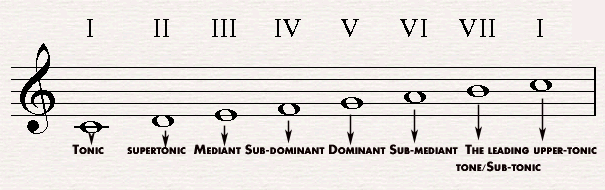
These are the names for each note in a scale, or scale degrees.

In music theory, a scale degree is the name given to a particular note of a scale to specify its position relative to the tonic (the main note of the scale). The tonic is considered to be the first degree of the scale, from which each octave is assumed to begin.

These are the scale degrees in Roman numerals.

The capitalised chords are the "power chords", the others are minors. The seventh chord is a diminished chord (scary movie music chord).

Music History

Music goes way back in since the start of mankind, but the vocal music and songs were far more recent. Here's how it went:
  • (Early 1400's) The Middle Ages
    This is significant because it was here at this time Europeans start using printing machines to record musical and historical events. 
  • (Late 1400's to Mid 1650's) Renaissance Era
    Vocal music was started by the church, and Latin was the predominant language used as it was the "classy" language of the time. They were primarily "Gregorian chants", named after Pope Gregory I. The other type of vocal music other than sacred music was secular music. This was anything not religious, e.g. dancing music, love songs, songs about the weather. The common type of song composition was madrigals.
This is an example of a secular piece composed in the Renaissance, a "rockstar" song of the time.

Dr. C. Smith - Waiting on the World to Change by John Mayer

This is an example of a Dr. C. Smith music analysis of the John Mayer Grammy award-winning blues rock soul song.
D = mf = mezzoforte, or moderately loud.
R = Regular chords, melody syncopated
C = D major
S = First Verse, Chorus, Bridge/Interlude, Instrumental,
M = Octave - syncopated
I = Glockenspiel, Band (Guitar & Drums), Horn,
T = Mainly homophonic - band/voice
H = 8 chords repeating - ostinato/riff

This is the music video for the song.

Saturday, December 12, 2015

Intro to Songs of Unity

Today we started by writing a reflection about both of our performances, saying our comments and critiques, which one we thought was better and why, the pros and cons, etc. Then, Mr. Karena told us about our new unit: Songs of Unity. We talked about how there are different types of songs that unite people, like religious music or negro spirituals and many more. Then Mr. Karena told us our assignment was to create a performance of a song of unity and add our own twist to it. He showed us an example of a group from the first year in Hangzhou (fun fact: one member was my sister). Our class has 8 people, so we can randomly got sorted into two groups of 4. My group includes me, Hannah, Celine, and Arnold. We then brainstormed about possible songs and came up with this list:
Man in the Mirror
We are the World
Imagine
Try
Stronger
True Colors
I Won't Give up
Just the Way You Are
What a Wonderful World
All of the Stars

Come Together

Friday, December 11, 2015

Parents Weekend Performance VS Sunday Performance


We performed on Sunday night on December 6th as a second assessment to give us a chance to improve our performance grades, then we were given the choice between these two performance and say which one we preferred and why. After performing twice and watching both over afterwards, I personally think my first performance was better. This is for several reasons. Firstly, because during the second performance the "whiplash" (basically the amount of reverberation of the string that sounds very bad) was much worse. Additionally, my voice was almost completely inaudible in the second performance, while in the first my voice sounded much louder and more confident because it was amplified from the mic. Even though both times I was nervous, the first time was more genuine and the nervousness propelled me to do better, while the second time the nervousness brought me down. I also practiced more before the first performance because I thought for granted that the second time would be easier because I'd done it before, when it wasn't and I was shaking and didn't play well or project as well. I think the second time my playing of the chords was more technically correct and I made less mistakes in the finger work, but overall the I think way the guitar sounded and ironically my confidence and how my voice sounded was much better in the first time.

Saturday, November 28, 2015

27/11/2015 Lion Dance Music Composal

27/11/2015: Today in class we created a 2 minute 10 second long lion dance accompaniment track with our knowledge of musical and rhythmic components, as well as binary.

Friday, November 20, 2015

Rhythmic Fruit Salad

Displaying IMG_9045.JPG


Today in class we started a new unit about drumming patterns. Mr. Karena showed us this nice way to remember how to play each rhythm in this "rhythmic fruit salad".